


Computer system validation and equipment qualification are fundamental requirements that determine the success of your pharmaceutical company. In fact, these processes are mandatory for regulatory compliance because they are key to guaranteeing product quality and patient safety.
To comply with regulations established by the FDA (Food and Drug Administration) and the EMA (European Medicines Agency), you need to understand the difference between qualification of equipment and facilities and validation of computer systems. These processes are essential to maintain data integrity and traceability of all your processes with GxP relevance.
In this article, you will learn the key differences between qualification and validation, the specific requirements of each process, and how to implement them correctly in your company to guarantee regulatory compliance and operational quality.
Fundamentals of qualification and validation
To fully understand the process of equipment qualification and computer system validation within the pharmaceutical industry, you need to familiarize yourself with its fundamental concepts.
Qualification is a documented process that proves that your equipment and facilities are suitable for their intended purpose. It focuses on verifying that equipment meets installation, operation, and performance requirements.
The five essential stages of qualification are:
- User Requirements (URS – User Requirements Specification): Description of user requirements for the specific equipment or facility.
- Design Qualification (DQ – Design Qualification): Verifies that the equipment design complies with Good Manufacturing Practices and user requirements.
- Installation Qualification (IQ – Installation Qualification): Confirms that your equipment is installed according to specifications and updated drawings.
- Operational Qualification (OQ – Operational Qualification): Demonstrates that your equipment operates within established limits.
- Performance Qualification (PQ – Performance Qualification): Ensures that the equipment operates consistently under normal operating conditions.
The regulatory framework governing these processes is established mainly by Good Manufacturing Practices (GMP). Particularly, Annex 15 of EU GMP entered into force on October 1, 2015, establishing fundamental requirements for qualification and validation in the manufacture of medicinal products.
Furthermore, the FDA highlights that equipment qualification is an integral part of the validation process.
Computer system validation, on the other hand, is the review process to which a computer system is subjected to check that it functions according to its intended use and is capable of doing so in compliance with applicable regulations.
Validation of a computer system must not only consider the software operation as an IT solution, but must encompass the entire operational framework surrounding it, such as:
- Hardware and software forming part of the solution
- Standard Operating Procedures (SOP)
- System administration and governance procedures
- Data integrity management
- Personnel training records
Fundamental differences between qualification and validation
While qualification of equipment focuses on verifying the operation of physical hardware as intended, computer system validation aims to prove that the software managing critical information operates in a robust, repeatable manner and in compliance with current regulations.
Specific documentary requirements
For qualification, the necessary documentation is as follows:
1) Qualification Plan, describing all components of the equipment to be installed, specific operational or safety requirements, task planning, among other aspects.
2) Design and installation documentation of the equipment.
3) Qualification protocols verifying design (DQ), installation (IQ), operation (OQ), and performance (PQ) of equipment according to user requirements. Typically, this verification is performed in two steps:
- FAT (Factory Acceptance Testing) – Verification of equipment at provider facilities.
- SAT (Site Acceptance Testing) – Verification performed once equipment is installed in its final location within the pharmaceutical laboratory facilities.
4) Qualification report to close the qualification process.
For validation of a computer system, the general life cycle consists of the following deliverables:
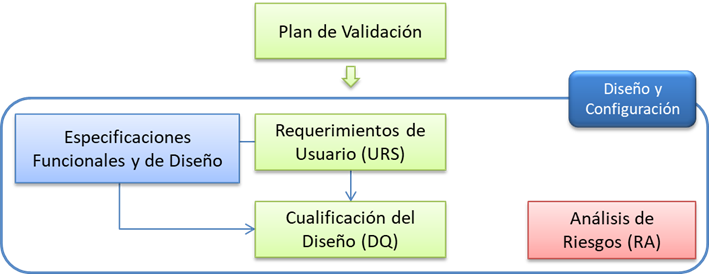
1) URS (User Requirement Specification) - Document describing user requirements for the system. Beyond functional requirements, it is advisable to incorporate technical, regulatory, and security requirements.
2) VP (Validation Plan) - Document describing the strategy, stages, and activities comprising system validation.
3) FS (Functional Specification) - Document issued by the software vendor detailing how the system is configured to function as intended.
4) RA (Risk Assessment) - Identification and mitigation of risks. This document determines the scope of verification testing.
5) DQ (Design Qualification) - Assurance that the design proposed by the system vendor covers the functional requirements.
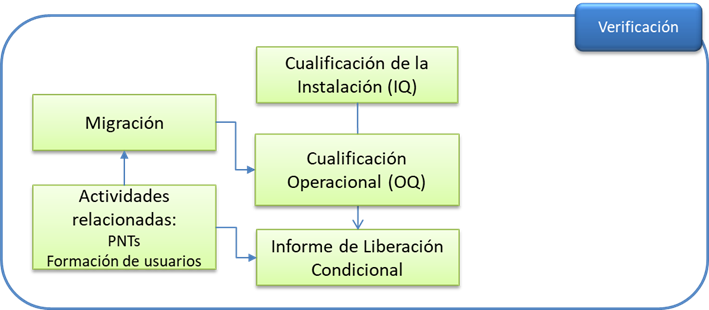
6) IQ (Installation Qualification): Verification that the system is installed correctly.
7) OQ (Operational Qualification): Checking that software functions according to defined requirements.
8) Data Migration: In some cases, information migration between systems may be necessary. Tests ensuring accurate, complete, and intact migration of affected data must be included.
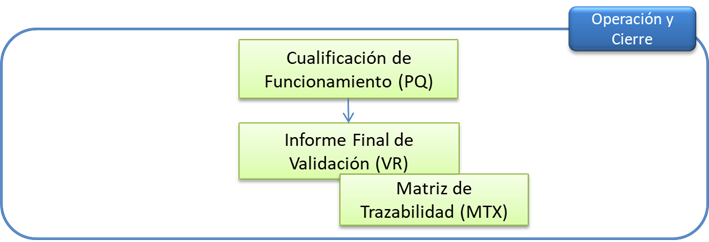
9) PQ (Performance Qualification) – Validates operation in real operations.
10) VR (Validation Report) – Formal closure of validation with pertinent results and conclusions.
11) MTX (Traceability) – Traces all validation activities performed from requirements to executed tests.
Beyond documentation generated during validation, regulated companies must have a procedural framework ensuring proper software governance, administration, and maintenance once validated.
To do this, it is essential to carry out two key activities:
- The personnel training responsible for operating and managing the computer system.
- The availability of Standard Operating Procedures (SOPs) supporting operation and maintenance. Among others, some of the most important are:
- User management
- System usage
- Change management
- Incident management
- Periodic review
Document management is a requirement to consider, being defined in Chapter 4 of EU GMP.
Applicable regulations and standards
To guarantee the success of your qualification and validation processes, you need to understand the regulatory framework governing these activities. Regulations and standards establish minimum requirements you must comply with to maintain the quality and safety of your pharmaceutical products.
GMP y FDA requirements
Good Manufacturing Practices (GMP) constitute the fundamental pillar of pharmaceutical quality. Specifically, GMP requires that you:
- Identify validation tasks necessary to prove control of critical aspects
- Validate any significant change to facilities, equipment, and computer systems
- Use a risk assessment approach to determine validation scope
- Complete validation of computer systems prior to use
Additionally, the FDA establishes that equipment qualification must be an integral part of your validation program. Consequently, you need to implement strict controls in production areas, such as particle monitoring in cleanrooms.
Specific regulations for computer system validation in European and US markets are described by:
- Annex 11 EU GMP, Computerized Systems
- 21 CFR Part 11, Electronic Records; Electronic Signatures
ISO and recent regulatory updates
In 2022, significant updates were made to key standards affecting cleanroom qualification. Specifically, EU GMP Annex 1 on sterile medicinal product manufacturing and ISO 14644-4:2022 established new requirements for:
- Cleanroom design and construction
- Qualification processes
- Operational environmental monitoring
Consequently, you must ensure your qualification and validation processes remain updated according to these new requirements.
Requalification of cleanrooms must be performed periodically following defined procedures, and all process changes must be formally documented and evaluated based on their impact on the validated state.
Qualification and validation as a team
Qualification and validation work together to guarantee product quality, regulatory compliance, and patient safety throughout the manufacturing process of a medicinal product. Their success depends on staying up to date with regulatory requirements, which provide clear guidelines to maintain GMP compliance.
Qualification focuses specifically on equipment and facilities, requiring specific documentation across DQ, IQ, OQ, and PQ stages. Validation, on the other hand, encompasses a broader review process of the entire computer system according to current regulations, guaranteeing consistent quality results across the production chain.
Connect with us
At Ambit BST, we offer consultancy, audit and specialist training services to help you excel in the regulated sector. Click here to get in touch with us.
At AMBIT BST, we have been experts in developing IT strategies and solutions for over 20 years. We help the pharmaceutical, medical device and IVD (in vitro diagnostics) sectors to comply with regulations throughout the product lifecycle. We design and implement innovative infrastructures through a comprehensive range of services that act as a catalyst for digital transformation.






Cuéntanos tu opinión